
247 business processes. 94.8% executed by software.
One client. One industry. Several years in production. Here is what the method produces when it runs long enough — and here are the limits of what these numbers prove.
1,809 nodes. 469 decision points. It asks a person 82 times.
This is not a diagram we drew to illustrate a point. It is the flagship process itself — the same shapes, in the same places, in the same colours the modelling tool uses, read straight out of the file the engine runs.
- 0Nodes drawn — checks, actions, notifications, deadlines
- 0Decision points the engine resolves on its own
- 0Steps that stop and ask a person
- Condition — the engine evaluates it
- Action or notification — it happens by itself
- Decision — the process chooses a path
- A person — 82 of them, in all of this
- Start, end, deadline
Zoomed out to fit, exactly as you would see it in the tool. The boxes carry names on screen; here they are left blank, because the shape is our work and the content is the client’s.
Why it looks dense
Because it is. A process that covers leasing, compliance, finance and HR end to end has this many branches whether or not anyone writes them down. The difference is that here they are written down.
The orange diamonds are the argument
469 points where the process chooses. A workflow tool moves a record from one status to the next; it has no model to choose from. This one decides, and only stops to ask when the answer needs judgement.
Count the dark boxes
82, in all of that. They are spread across the whole diagram rather than piled at the end: judgement is asked for where it matters, not batched into a queue.
A human touch on 4.5% of the path.
Everything else — the checks, the routing, the documents, the notifications — happens on its own.
A useful question for any software vendor: how many decision branches does your equivalent process contain? The answer is usually zero. Not because the software is bad, but because it has no model of the process at all. It records what you already decided. It does not decide.
Drawn this way, the 469 diamonds are the argument. A workflow tool moves a record from one status to the next. A process engine chooses, 469 times, which of several things should happen — and only stops to ask when the answer needs a person.
A process engine, not a CRM someone configured.
DREAM is a business process platform designed and built by HYA for a Dubai real estate operation — leasing, sales, property management, accounting, HR and compliance, governed end to end.
It is not a system of record that captures decisions after they are taken. It is a process engine: 247 BPMN processes modelled and running in production, each with its own decision branches, automatic checks, generated documents, timers and notifications. Published on the Apple App Store and Google Play.
| 247 | Business processes modelled and running in production |
| 11,918 | Nodes across the process diagrams |
| 14,218 | Connections between those nodes |
| 10,113 | Business rules codified across 1,053 data fields |
| 101 | Business modules covered end to end |
14,218 connections across 11,918 nodes means these processes branch. They are not linear checklists, they are decision trees. That is the difference between a workflow tool and a process engine.
All of that, behind three taps.
The engine runs underneath. What a landlord or a tenant sees is an app that already knows the answer, because the process produced it.
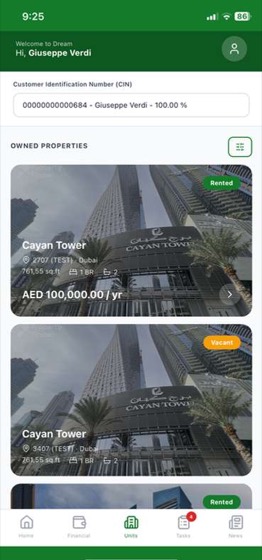
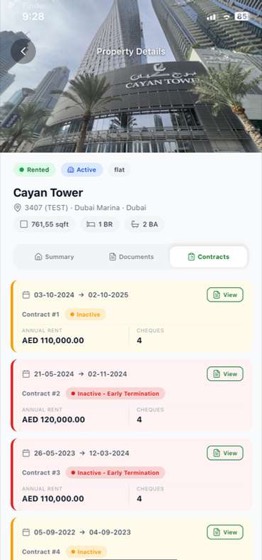
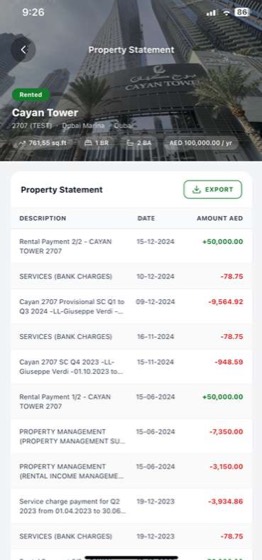
Screens from the published application, captured on a demonstration account — every name and figure shown is placeholder data. Listed as Dubai RE Asset Management on the Apple App Store and Google Play, so the claim is verifiable rather than asserted.
7,565 steps run without a person. 419 don’t.
Of 7,984 operational steps across the platform: 7,565 executed by software, 419 by a person — 94.8% automated.
165 of the 247 processes run end to end without touching a person at all. The 82 that do involve someone ask for them, on average, five times across an entire process. Not five hundred.
45 processes contain an explicit human approval or signature step, addressed to named roles rather than a generic inbox. Automation did not remove the control. It concentrated it where control is worth something.
| 2,784 | Decision points encoded |
| 270 | Timers and scheduled waits |
| 205 | Documents generated automatically |
| 1,092 | Automatic notifications |
The system remembers so nobody has to: insurance renewals, visa and identity document expiries, licence deadlines, contract anniversaries, payment instalments. Nothing depends on someone opening a calendar.
No strong module and nine window displays.
It is easy to automate one showcase area and leave the rest manual. Across the ten business areas covered — from leasing and compliance to finance, HR, facilities and fleet — no area falls below 93% automation.
| Business area | Processes |
|---|---|
| Leasing & tenancy | 47 |
| Compliance & documents | 34 |
| Finance & accounting | 29 |
| HR & payroll | 23 |
| Six further areas | 114 |
What these numbers are — and what they are not
They are a measurement
Every figure comes from parsing the live process definitions, cross-checked by a second independent method. Node counts matched exactly across all ten node classes.
They are not hours or money saved
These files contain process definitions, not execution records. We could publish a return-on-investment figure. It would be invented, and you would be right to distrust the rest of the page because of it.
The conservative reading is 91.2%
Automatic condition checks are counted as software steps, because the engine evaluates them. Count only active automated actions and the figure is 91.2% instead of 94.8%. The argument does not change.
We publish the limits because a platform this size does not need to be oversold. Client identity and internal process names are withheld deliberately: what is published here is scale and structure, not the client’s business.
Your business isn’t real estate. The method doesn’t care.
DREAM is what happens when process design, BPMN modelling and software engineering are applied by the same people, to the same company, for years.
The industry is incidental. What transfers is the method: watch the work, model it in a standard notation, cut what only survives out of habit, make the remainder executable, and keep human judgement at the points that carry risk.
About these figures
What is DREAM?
DREAM — Dubai Real Estate Asset Management — is a business process platform designed and built by HYA for a Dubai real estate operation, covering leasing, sales, property management, accounting, HR and compliance. It runs 247 BPMN processes in production and is published on the Apple App Store and Google Play.
How were the 94.8% and the other figures measured?
By parsing the live BPMN process definitions of the running platform and counting nodes by class, then verifying the result with a second independent method — direct inspection of the XML tags against the parsed graph. Counts matched exactly across all ten node classes. The headline figure is 7,565 software-executed steps out of 7,984 operational steps.
Why don’t you publish hours or money saved?
Because we do not have the data that would support it. The export contains process definitions, not execution records, so any return-on-investment figure would be an estimate presented as a measurement. We would rather publish a smaller true claim than a larger invented one.
Why is the conservative figure 91.2%?
Because it depends on how you treat automatic condition checks. The engine evaluates them, so we count them as software steps, giving 94.8%. Count only active automated actions — records created, emails sent, documents generated — and the figure is 91.2%. Both numbers describe the same platform; we publish both.
Who is the client?
We do not name them, and we do not publish internal process names or any operational data from the installation. What is published is the scale and structure of the modelling work, which is HYA’s own work product.
Does this mean HYA only works in real estate?
No. Real estate is where this particular platform was built, and it happens to be a demanding test because leasing, compliance, finance and HR all have to interlock. The method — map, model in BPMN, cut, make executable, concentrate control, hand over — is industry-independent.
Start with a Process Audit.
Two weeks looking at how your company actually works. You get the map, the bottlenecks that cost you most, and a costed plan to fix them in order of return — including whether the answer is software at all.
Two weeks · one senior consultant · scope and fee agreed before we start · you own the output either way.